Movement intelligence, made visible
Movement is a system. See every link.
Make one hidden relationship perceptible while you move. Review the complete mechanics after. Then reduce the guide and test what you can carry into the next attempt.
One cue in motion
Complete trace after
No-guide test
StrengthGait + balanceRecoveryMotor relearning
Movement-learning loop6 stages
- Sense
- Resolve
- Cue
- Adapt
- Review
- Own
Use the guide. Review the trace. Test what remains.
Stage 01Sense → selected source
The closed learning loop
Feedback is useful only if it becomes capability.
Online correction is the beginning. The system follows the signal through practice, reduced guidance, retention, and task transfer.
Mechanism
Movement creates a changing sensory state.
Vision, touch, vestibular input, effort, muscle and joint signals contribute to the person’s experience. External instruments can observe selected relationships—not the entire internal state.
- Failure test
- The selected target has no fit source.
- System response
- Declare the source and withhold unsupported output.
- Next proof
- Can the target be observed with acceptable quality and latency?
The SDA signal microscope
Zoom from mechanism to outcome. Then trace the conclusion home.
One conclusion is tested at every scale. Change the scale, inspect the chain, and interrupt the cue when its source is not good enough.
Intrinsic stateExternal system
Signal pathsource gate accepted
Mechanism of action
Augment perception without replacing intrinsic sensation.
A selected movement relationship becomes visible, audible, or tactile while the person acts. The cue joins the person’s own sensation; it does not claim to read the full internal state.
Signal-quality gate
Bad input does not become a confident cue.
Change capture quality to see whether the live instruction is allowed through.
Signal quality demo input
Cue deliveredsource and latency gates passed
Live perceptual augmentation
Do not wait until the set is over to understand it.
A single primary cue stays glanceable in motion. The complete mechanics trace remains available after the attempt.
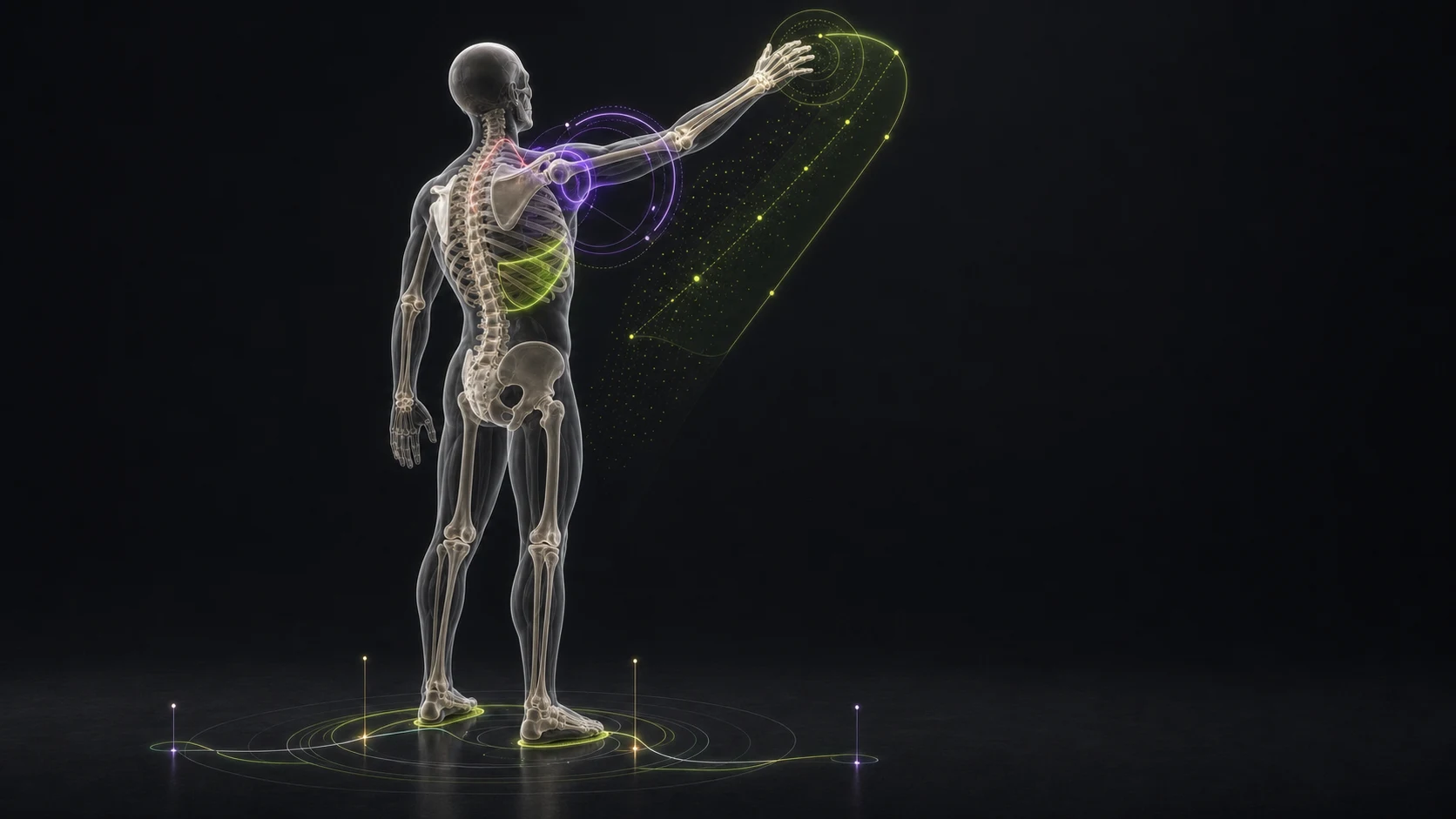
Selected relationshipscapula · humerus · thorax
Feedback design studyhigh-elevation cue
Choose the perceptual channel
Path window
keep the relationship inside the live corridor
Vision carries a spatial relationship. The full trace is deferred until the attempt ends.
Observedlandmark trajectories
Calculatedrelative segment motion
Qualityaccepted for cue
From guidance to ownership
A better repetition is not yet a learned capability.
The system changes the feedback schedule and tests whether the movement survives without the display.
Online performance
The cue is present while the person moves.
Use immediate response to tune the target and delivery—not to claim durable learning.
Test: does the selected variable change in the intended direction?One engine, many movement contexts
Strength leads. Human movement is the platform.
The control contract is shared. The sensor, target, safety system, evidence, and outcome remain specific to the person and task.
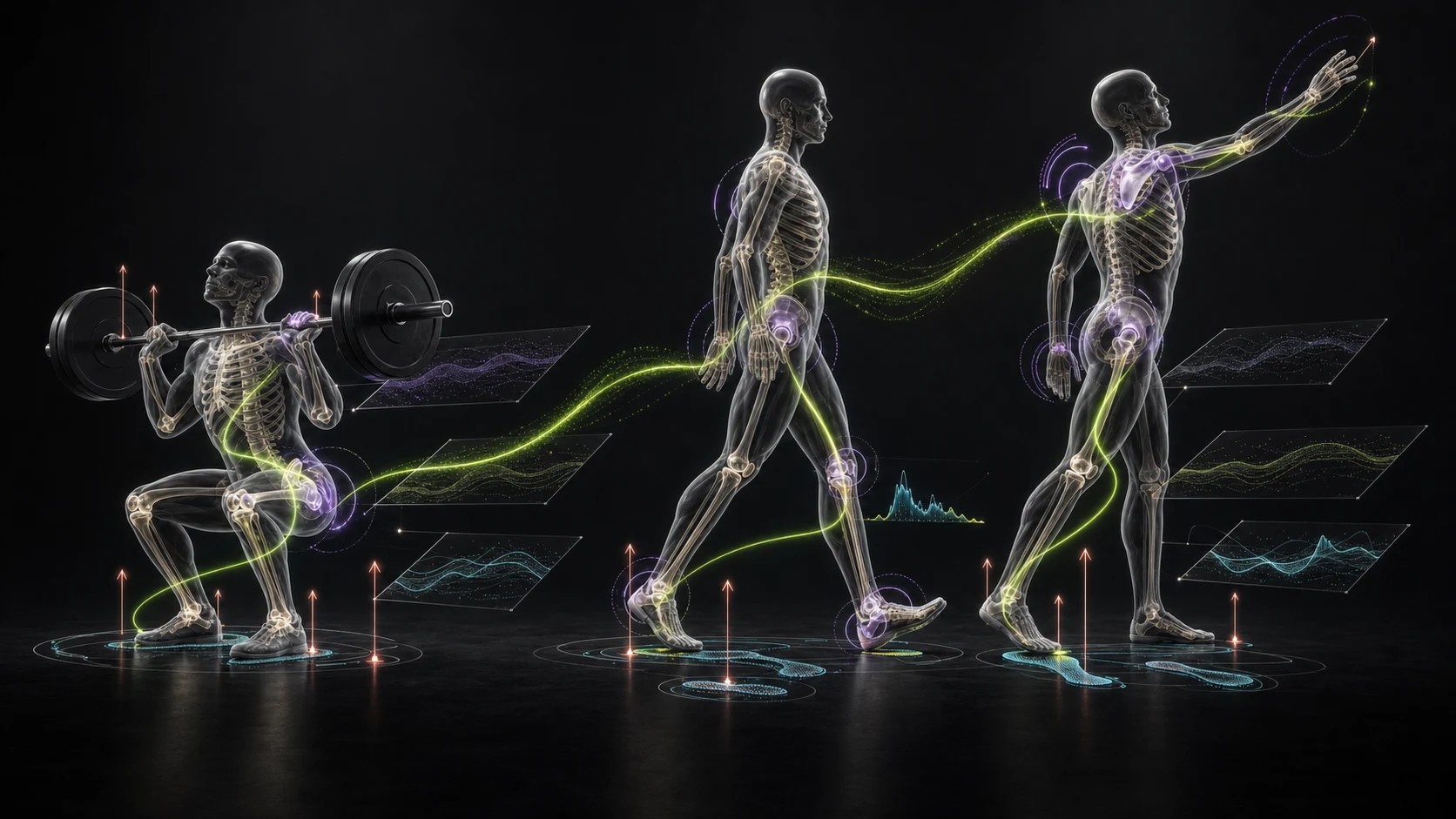
01Strengthload · phase · strategy
02Gaittiming · contact · balance
03Reachcoordination · control · task
Goalwhat matters→Targetwhat changes→Sensorwhat can see it→Gatewhen to trust it→Cuewhat is perceptible→Testwhat remains
Train a deliberate strategy.
Relate task, load, segments, phase, and a matched biosignal when the target requires one.
Make timing and contact usable.
Configure the engine around walking, turning, environmental demands, and the exact outcome under test.
Rebuild a named movement task.
Follow the prescribed target, stage, envelope, and safety system—then test function beyond the display.
Make subtle attempts perceptible.
Pair person-specific task practice with a fit signal, manageable cue, repetition, and retention testing.
Shoulder proof case
Raising an arm is a whole-system event.
The humerus, scapula, clavicle, and thorax coordinate throughout elevation. Their relationship changes with phase, task, load, direction, and person.
One angle is a sample. Coordination is the story.
Phase selected arm-elevation phase
Variable relative humeral–scapular motion
Method declared segment coordinate definitions
Source landmark trajectories with capture quality
Quality source operating gate remains attached
Interpretation phase-specific movement description
Arm-elevation relationshipstylized phase relationship
RestEarlyMidHighEnd
The recursive trust trail
Biomechanics becomes useful when every conclusion can travel back to its source.
Not a confidence badge. Not an unexplained form score. A predictable path through what was observed, what was calculated, what a model estimated, and what the outcome test established.
Attached to capture
Landmarks, trajectories, contact, external load, or a named biosignal.
Source + quality remain attached.Attached to method
Angles, timing, range, phase, and declared coordinate relationships.
Definition + assumptions remain attached.Attached to a model
Internal quantities only through a named model and its required inputs.
Uncertainty + limits remain attached.Attached to the endpoint
Guided change, no-guide retention, task transfer, and real outcomes stay distinct.
Test + timepoint remain attached.A separate lane
Men’s Health.
A distinct research and product program within SDA Biomechanics, with its own framing, privacy architecture, evidence, and release path.
Private by designseparate data and access boundariesMethod before claimevidence matched to the exact use caseDeliberate releasespecific language after program review

From strategy to source
Describe the strategy.
Show the tradeoffs.
Use the guide. Review the trace. Test what remains.
Trace the system